
In 1991, Crossing the Chasm was released and it quickly became the marketing Bible for technology entrepreneurs. Since then, Geoffrey Moore’s business classic has been updated twice and remains one of the most relevant pieces in the modern marketing body of knowledge.
That is why I find it surprising that many technology marketers and entrepreneurs I have met with over the past year or so have never heard of it. Little do they know they are at risk from those who are actively applying Moore’s concepts and putting them into action in both strategy and marketing communications!
Although Crossing the Chasm was written 20 years ago, it remains one of the most important technology marketing books of all time. Ignore it at your risk!
The Technology Adoption Lifecycle
What made Crossing the Chasm so valuable, was how Moore synthesized the concept of the Technology Adoption Lifecycle, as described by Everett Rogers in his popular book Diffusion of Innovations first published in 1962, with his own insights.
Today the “Lifecycle” concept remains relevant and offers critical guidance on key marketing decisions, including strategy, content sequencing, messaging, market segmentation and more. Moore’s contribution in Crossing The Chasm was identifying what the Chasm is and how to cross it quickly before running out of time and money.
The graphic below illustrates the Lifecycle and where the Chasm is located.
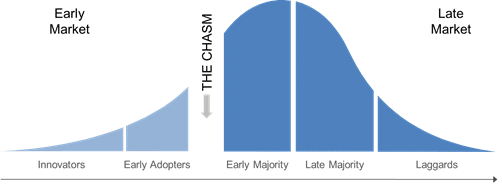
In the Technology Adoption Lifecycle, the market for a particular technology consists of five distinct stages, with each stage populated by a certain type of buyer, briefly described below.
Innovators (3.5% of total market). These buyers are willing to take a risk on something new, even if it isn’t completely proven. Innovators are looking to leap-frog over the competition by pioneering a technology with the potential to disrupt the status quo. If successful, they can redefine the competitive landscape and capture “first mover” advantage. Innovators tend to be visionary, comfortable with risk and usually have a higher social status (at least in their organizations) than others. They are often willing to pay a higher price to be the first to have something new. In the corporate world, it has been my experience that Innovators are a rare find.
Early Adopters (13.5% of total market). Like Innovators, Early Adopters are visionaries in that they see the possibilities inherent in successfully adopting a new technology, but they shun participating in “science projects.” In comparison to Innovators, Early Adopters find a practical application of the technology, sometimes different than what the inventor originally intended. Early Adopters believe that successful implementation of a breakthrough solution can help them achieve personal career goals, while simultaneously boosting their employer. Early Adopters are often an entrepreneur’s first meaningful customers. Startups need to pay careful attention to Early Adopters for quickly building a customer base.
The Chasm – the time and space between the Early Adopters and the Early Majority is the Chasm. This is where most startups fail, often as the result of several factors, but for whatever reason(s) once the investment capital runs out, its game over. Crossing the Chasm as quickly and efficiently as possible is the objective of the startup! If you run out of time, capital and resources, you will join all the other would-be Steve Jobs’ and Jeff Bezos’ at the bottom of the Chasm.
What made you successful with Visionaries and Early Adopters is not necessarily what will help you cross the chasm. Your messaging will have to adapt to the needs and preferences of the Early Majority, and you will need to adapt fast! Failing to adapt typically results in frustration, which can cause unforced errors your competition will exploit.
Early Majority (34% of total market). The Early Majority typically consists of middle management, not opinion leaders or executives. They are seeking to buy solutions that have been proved-up by the Innovators and Early Adopters. I frequently hear people in the Early Majority describe themselves as “fast followers.” What makes the Early Majority a critical target audience is their role as kingmakers. Once a technology is proven, the market seeks to elevate one provider as the de-facto standard to reduce risk and validate their choices. It is the Early Majority who decides who the big winners will be, and they are the buyers who will power double and triple-digital growth rates for the companies they crown kings.
Late Majority (34% of total market). A significant part of the market, and skeptical of innovation. If it ain’t broke, buyers in the Late Majority aren’t likely to buy anything to “fix” it. They represent a significant market opportunity, but only after a technology has been on the market for several years. In some cases, especially involving environmental performance technology, the Late Majority may only be moved by government regulations.
Laggards (16% of total market). Focused on tradition and the status quo, Laggards are the last to adopt a technology. Pay them no mind and quickly eliminate them from your sales funnel!
Why It Matters
Grasping the fundamentals of the Technology Adoption Lifecycle is essential for effective marketing communications, even for companies that are not selling a technology-based solution.
Implications:
- Buyers at each stage of the lifecycle have different psychologies and information needs, and effective marketers will customize their content and approaches accordingly.
- Avoid the frustration of stalled sales cycles. If you have an innovative Minimal Viable Product or service offering, chances are you have met with some success. What made you successful with Visionaries and Early Adopters, however, is not necessarily what will help you cross the chasm. Your messaging will have to adapt to the needs and preferences of the Early Majority, and you will need to adapt fast! Failing to adapt typically results in frustration, which can cause unforced errors your competition will exploit.
- Marketing programs for startups seeking widespread adoption of an innovative technology or idea need Thought Leadership pieces to create a vision in the minds of Early Adopters, data and case studies. These are the tools to bridge you over to the coveted Early Majority.
- Companies selling established services or products in highly competitive, mature markets have more need for consistent and frequent messaging through multiple channels. The name of the game here is to constantly maintain awareness and interest with buyers during the corporate buying cycle to ensure you are involved in as many bid processes as possible.
Let’s Talk! Schedule a free 30-minute Digital Marketing consultation to see if there is a fit between your marketing challenges and our capabilities.
About Prism Group
Prism Group is a full-spectrum, multi-talented B2B agency focused on Energy Tech, Technology, Energy, Services and Media markets. Our work is telling stories that matter, because our clients are working to change the world for the better. What makes us different is that we put into action the strategies we recommend – we get it done, so you can get results and increase the value of your business.
Contact
James Constas
President
Prism Group
JConstas@1PrismGroup.com